Champagne is the first winegrowing region to set up a carbon plan. This is a sign of the players' commitment to preserving resources.
To date, more than half of Champagne Viticole has been awarded environmental certification.
Sustainable viticulture
Sustainable viticulture, also known as viticulture raisonnée, aims to ensure the long-term future of the vineyard while preserving the environment.
Protecting natural resources is at the heart of this approach. Active biological life in the soil enables the vines to protect themselves naturally and limit the use of phytosanitary products. The grower benefits from regular, high-quality production.
With the Viticulture Durable en Champagne label, the region has had a reference system adapted to the characteristics of the Champagne terroir since 2001. This certification covers more than a third of the vineyards.
There is also another label. Terra Vitis is open to all French vineyards. It concerns some fifty vineyards on the Côte des Bar.
HVE
The H.V.E. High Environmental Value certification is governed by public authorities. It applies to the entire vineyard that benefits from it.
initiated in 2011, is a global approach to environmental protection. It regulates the use of pesticides in the vineyard, the frequency of treatments and the use of grass between the rows of vines.
There are 3 levels:
- Level 1: compliance with environmental regulations. This is an essential prerequisite for access to the other levels.
. Level 2: compliance with a reference system of good environmental practices, comprising 4 themes (biodiversity, fertilization, phytosanitary protection, water management). This is an obligation of means. This level is not compulsory for access to level 3.
- Level 3: this is the only level that can be used to obtain the "High Environmental Value" label. It requires results in all 4 areas. The farm's environmental performance is assessed by precise results indicators, such as the frequency of treatments.
Viticulture Durable en Champagne and Terra Vitis are recognized as equivalent to level 2.
ORGANIC AB
Organic certification is a label for the end product (grapes, champagne), not the farm.
Organic production is based on respect for natural systems and cycles, maintaining and improving the health of soil, water, plants and animals. It aims to enhance biodiversity and animal welfare.
It essentially consists of an obligation of means, with:
- a ban on the use of GMOs (Genetically Modified Organisms) and synthetic chemical products,
- a ban on chemical weeding,
- the use of certain authorized inputs (vine protection products, fertilizers, oenological products, etc.).
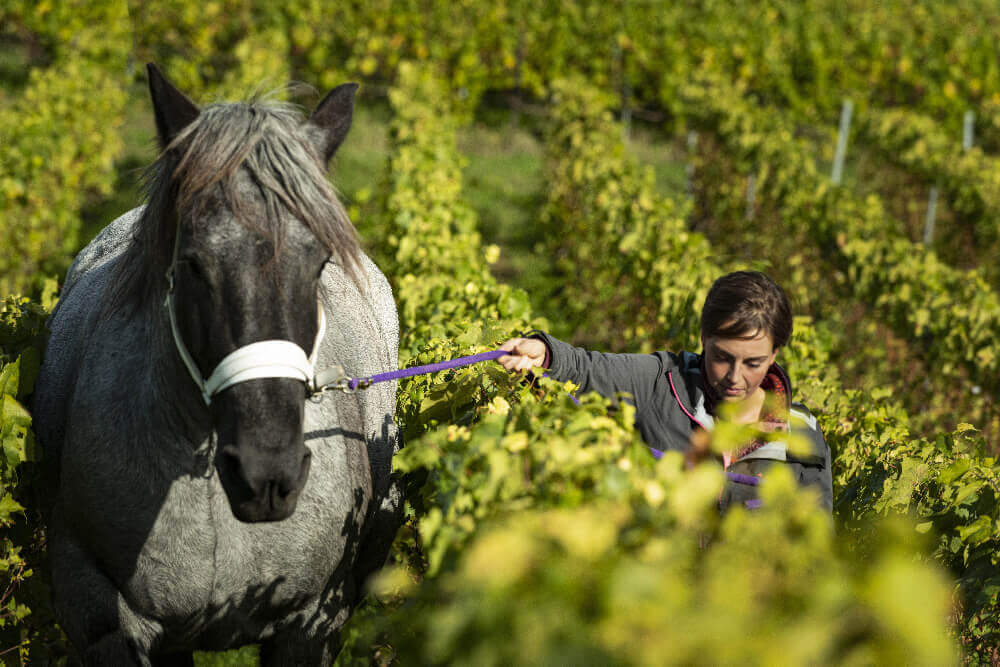
Champagne De Sousa
BIODYNAMY
Biodynamic viticulture is based on a holistic approach. Particular importance is given to biodiversity, the influence of the Moon and the planets, and the use of natural preparations on the soil.
The vineyard is conceived as a living organism in which the winegrower plays a central role through his ability to observe, understand and act with the living beings that surround him.
Biodynamic viticulture isstill rare in its application: to date, around ten Champagne winegrowers bear the Biodyvin label, barely more than for Demeter certification.
See all Organic Champagnes
Biodynamic soils
In 2021, the journal Environnemental Chemistry Letters published a study conducted by researchers at the French National Institute for Agricultural Research. It focuses on soil biology. It concludes that biodynamic farming has the best ecological soil quality, followed by organic farming, then sustainable farming and finally conventional farming.
certification
More than half the vineyards have environmental certification. The aim is to reach 100% of vineyards by
2030.
While the quality of champagne is a global issue, from the terroir to the mastery of the various stages of production, the elements induced by an environmental approach can also have an impact.
Ecolabels
The impact of eco-labels has been studied by two economists on 130,000 wines.
Certified organic and biodynamic wines are judged to be better than conventional or integrated wines, according to ratings recorded between 1995 and 2015 in three major wine guides.