

How do you recognize a great Left Bank wine?
The essentials
A great wine from Bordeaux’s Left Bank is characterised by its ripe, fine-grained tannins, its aromas of dark fruits (blackcurrant, blackberry), graphite and cedar, and its remarkable lingering finish. Cabernet Sauvignon, the king of grape varieties in these gravelly terroirs, lends it structure, depth and exceptional ageing potential.
- What is the difference between a wine from the Left Bank and a wine from the Right Bank of Bordeaux?
- The left bank of Bordeaux is dominated by Cabernet Sauvignon, grown on gravelly soils, which produces structured, tannic wines that are well suited to ageing. On the right bank, Merlot predominates, lending the wines greater roundness.
- At what temperature should a fine red wine from Bordeaux’s Left Bank be served?
- A fine red wine from the Left Bank is best served at between 16°C and 18°C. If it is too warm, the alcohol overpowers the fruit; if it is too cold, the aromas become closed and the tannins become harsh.
- Should a fine red wine from Bordeaux’s Left Bank be decanted?
- For a Left Bank wine less than 10–15 years old, decanting for 1 to 2 hours softens the tannins and releases the aromas. For an older vintage, decanting serves solely to separate the wine from its sediment, just before serving.
Gravel soils, Cabernet Sauvignon, graphite and cedar: behind every great wine from the Left Bank lie specific characteristics that can be identified.
The left bank of the Garonne River in the Bordeaux region is home to some of the world's most famous and coveted red wines. Home to Cabernet Sauvignon, this region produces wines renowned for their power, structure and incredible longevity. But how can you tell from a label what distinguishes a true Grand Cru from this exceptional terroir? Dive into the heart of the Médoc and Graves identity.
Understanding the identity of Left Bank wines
To recognize a great Left Bank wine, you must first understand the fundamental elements that shape its unique character: its soil and its king grape variety.
The role of gravelly soils in wine structure
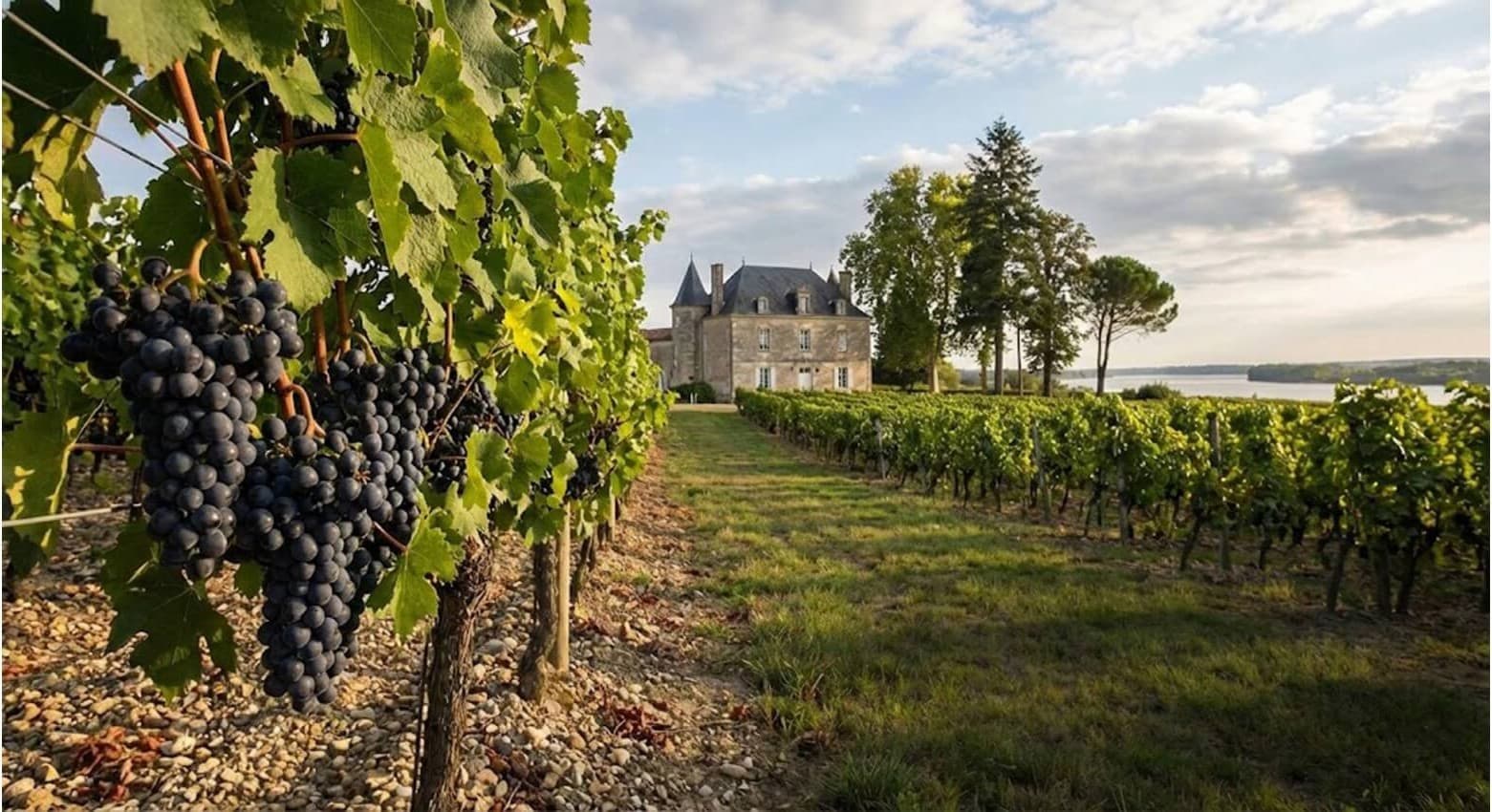
The keystone of the Left Bank's great wines lies beneath the vines: the gravel. These pebbles and gravels, carried by the river over the millennia, constitute a poor but providential terroir. They ensure perfect drainage of the soil and, above all, store up the sun's heat during the day and release it at night, promoting optimal ripening of the grapes. This difficult soil forces the vines to plunge their roots deep into the soil to draw nutrients, giving the wines an inimitable complexity and structure.
The importance of Cabernet Sauvignon
While Merlot dominates on the right bank, the left bank is the undisputed kingdom of Cabernet Sauvignon. This late-ripening grape variety thrives on warm gravelly soils. It is the backbone of the region's great wines. It provides the deep color, lively acidity needed for balance, intense black fruit aromas (blackcurrant, blackberry) and, above all, a solid tannic structure. Although it is often blended with Merlot (for roundness) and sometimes Petit Verdot or Cabernet Franc, it is Cabernet Sauvignon that dictates the style of the wine.
Wines renowned for their ageing potential
Thanks to a combination of powerful tannins, good acidity and controlled alcoholic concentration, the great wines of the Left Bank are built to last. They don't give themselves away easily when young, sometimes displaying a certain austerity. It's this alchemy that allows the birth of exceptional nectars, like a Chateau Margaux wine, capable of enduring the decades while gaining in complexity, transforming its initial ardor into a velvety texture.
The characteristics of a great Left Bank wine
When tasting, several sensory markers help identify the superior quality of a Left Bank cru.
A solid yet elegant tannic structure
This is often the first contact on the palate. A great Left Bank wine has present, sometimes firm, tannins that coat the palate. However, the mark of a great wine is that these tannins are never green, drying or rustic. They are ripe, "polished", forming a tight but fine-grained framework, promising a silky evolution after a few years in bottle.
Complex aromas of black fruit, graphite and cedar
The nose of a great rive gauche is an olfactory voyage. In its youth, it bursts with notes of pure black fruit (crème de cassis, blueberry). With barrel ageing and time, the bouquet becomes considerably more complex. Characteristic notes of "pencil lead" or graphite (typical of gravelly soils), cigar box, cedar, and sometimes hints of menthol or sweet spices.
Remarkable length on the palate
It's one of the most reliable judges of the peace. After swallowing (or spitting out) the wine, the aromas must persist for a long time in the mouth. This is measured in "caudalies" (seconds). A great wine doesn't fade away; it leaves a sapid, complex imprint that lasts for long seconds, a sign of great concentration and successful balance.
A capacity to evolve harmoniously over time
A great wine is not static. Over the years, its deep ruby color tends toward garnet, even tile. Its primary aromas of fresh fruit will give way to fascinating tertiary notes of undergrowth, leather, truffles and light tobacco. Recognizing a great wine also means perceiving its potential to evolve into the complex harmony we call "bouquet".
Emblematic appellations to know
Although they share a common philosophy, the different communal appellations on the Left Bank offer distinct nuances.
Margaux: finesse and florality
The Margaux appellation, the largest and most southerly in the Médoc, is famous for producing some of the most feminine, elegant wines on the Left Bank. If structure is present, it's often wrapped in a silky texture and, above all, a fragrant nose with characteristic floral notes (violet, rose) mingling with red and black fruits.
Pauillac: power and nobility
Pauillac is often considered the quintessential "rive gauche" style. It is the temple of controlled power and density. The wines here are deep, full-bodied, with rich tannins and phenomenal ageing potential. The nose is often marked by intense blackcurrant and that famous pencil lead note.
Saint-Julien: perfect balance
Situated geographically between Margaux and Pauillac, the Saint-Julien appellation is often described as the perfect synthesis of the two. It combines the elegance of the former with the power of the latter. Saint-Julien wines are renowned for their great consistency, harmony and charm, even in intermediate vintages.
Saint-Estèphe: structure and depth
To the north of the Médoc, Saint-Estèphe's soils contain slightly more clay mixed with gravel. Historically, this has produced more robust, earthy, structured wines, sometimes a little austere in their youth. Today, they retain this great freshness and structure, but with more roundness and fruit.
Pessac-Léognan: elegance and minerality
Located south of Bordeaux, this is the historic Graves appellation. The great reds of Pessac-Léognan are distinguished by their racy elegance and, very often, by their distinctive smoky and mineral notes superimposed on the fruit, the signature of this specific terroir.
Tips for tasting a great Left Bank wine
To appreciate all the nuances of these complex wines, a few rules of service are essential.
Ideal temperature
Serving a great red wine too warm will bring out the alcohol to the detriment of the fruit; too cold will mask its aromas and harden its tannins. The ideal serving temperature is between 16°C and 18°C. If the bottle comes from a cool cellar, allow it to gently warm up in the room before serving.
Decanting: when and why
Decanting is often beneficial, but for different reasons depending on the age of the wine.
- For a young wine (less than 10-15 years old): A vigorous decanting one to two hours before serving will aerate the wine, soften its fiery tannins and "open" its nose.
- For an old vintage: The decanter is primarily used to separate the wine from its sediment (decantation). This operation should be gentle and carried out just before serving, to avoid sudden oxidation that could "kill" the fragile aromas of a venerable wine.
Suitable lenses
Forget the champagne flute or small bistro "balloon" glass. A great Left Bank wine needs room to express itself. Choose a Bordeaux-style glass, with a chalice (the bowl) wide enough to allow good aeration during shaking, and a rim slightly narrower to concentrate aromas towards the nose.