Storing Champagne
Champagne is a delicate product. It requires special care to ensure that its qualities and characteristics remain intact until it is served.
The ideal conditions are a cool, well-ventilated space, protected from light, with no temperature fluctuations or vibrations, odour-free, and with a humidity level not exceeding 70 per cent.
These conditions are generally found in traditional cellars, which are perfectly suited to storing Champagne.
However, it is not always possible to find a space that meets all these criteria. Wine cellars or wine cabinets can be a suitable alternative. The temperature should then be set between 10 and 12°C.
Light: the enemy of champagne
Champagne is highly sensitive to light.
If exposed to the fluorescent lighting in some shops or to natural sunlight, it will lose some of its qualities. This will be evident when tasted.
The defect resulting from prolonged exposure to light can affect any type of wine. It is known as a ‘light-induced off-flavour’. It is characterised by the deterioration of the champagne:
• a reduction in colour intensity,
• a diminishment of fruity notes,
• the emergence of reduced aromas reminiscent of cauliflower or wet wool.
This is due to the conversion of volatile compounds into methanethiol, a colourless, foul-smelling gas.
This defect is detrimental: it is irreversible and significantly degrades the characteristics of the champagne, rendering it unfit for consumption.
Some cuvées are sold in clear bottles. Whilst this may be seen as a mark of originality, it is essential to ensure the correct storage conditions. These bottles are generally placed in an opaque box or wrapped in film containing a UV filter. They are thus protected from light.
It is best to buy from local suppliers or specialist wine retailers to avoid any disappointment.
How to store champagne
Storing bottles on their sides helps to keep the cork supple and airtight, in contact with the liquid.
It is therefore generally accepted that bottles should be stored lying flat.
Conversely, a cork that is not in contact with the liquid gradually dries out. It shrinks in size and loses its airtight properties. This allows the gas inside the bottle to escape and creates an exchange with the outside air.
This also happens with bottles kept in the fridge for too long, where the dry air dries out the cork. The consequences are irreversible. They result in a loss of fizz and an alteration of the aromas and flavours.
Some people, however, choose to store bottles upright, in a vertical position.
The argument put forward is that the pressure inside the bottle keeps the cork moist, whether the bottles are laid down or stood upright. This practice remains, however, in the minority.
Whilst it is true that the horizontal position is commonly adopted, this is borne out by the quality of the oldest champagnes found in this very position.
How long does champagne keep?
Apart from storage conditions, the shelf life depends on the quality of the champagne and the size of the bottle.
Thus, a high-quality champagne that has undergone extended ageing has a high ageing potential. It can be kept for 10 to 15 years, or even longer if conditions are favourable. Conversely, a younger champagne, such as a non-vintage Brut with limited ageing, should be consumed within a maximum of 3 to 5 years.
Indeed, unlike still wine, the aromas of champagne no longer evolve once the final cork has been fitted and secured by the wire cage. The ageing process takes place during the final fermentation, whilst the wine is maturing.
As the yeasts are removed during disgorgement, the champagne is stabilised before being sold.
The size of the bottle is also a factor to consider. Champagne keeps better in a magnum than in a half-bottle.
This is due to the volume of air in the bottle relative to the volume of liquid. Prolonged, significant contact between the wine and oxygen causes oxidation. This alters the aromas, reduces the wine’s freshness and darkens its colour. A distinctive bitter taste reminiscent of Madeira wine develops, hence the somewhat misleading term ‘Maderised champagne’.
Reduction
Some champagnes may be prone to reduction.
This fault is characteristic of wines whose winemaking process has not been perfectly controlled.
It is in fact caused by a lack of oxygen.
It alters the taste of the champagne and imparts aromas of stagnant water, cabbage or even garlic, sometimes accompanied by a bitter aftertaste.
How should you store an OPEN bottle of champagne?
If you haven’t finished the whole bottle, it can be kept for a few more days under certain conditions.
Firstly, you need to reseal the bottle to preserve the fizz.
Ideally, you should use a stopper that is completely airtight and suitable for this type of bottle. Various models are available. What sets them apart is their airtight seal and their ability to withstand pressure.
The bottle should then be stored away from light and odours, in a cool place at a constant temperature.
The world’s oldest Champagne
Around thirty perfectly preserved bottles, most likely containing Veuve Clicquot from the 1780s, were discovered by a team of divers in a shipwreck off the coast of Finland in 2010.
After more than two centuries in the Baltic Sea, at a depth of over 50 metres, this Champagne has benefited from ideal storage conditions: no light and a constant cool temperature. Its effervescence appears to have remained intact.
“This wine is absolutely fabulous. There are still lovely, fine bubbles,” said oenologist Ella Grüssner Cromwell-Morgan, who had the opportunity to taste it. “The palate is truly surprising – very sweet, yet still with some acidity,” she described. “This is because
champagne was much sweeter back when the fermentation process was not yet fully understood. ”
“After 170 years at the bottom of the sea, these wines have retained the intrinsic characteristics of Champagne,” explains Philippe Jeandet, from the Vignes et Vins de Champagne research unit at the University of Reims.
The researchers have identified an alcohol content of 9.5 degrees, a far cry from the 12.5 degrees currently found in champagne. “This is not a result of ageing. The most likely reason is that the climate was colder back then,” notes the researcher. He goes on to confirm that “the taste was much sweeter in those days. Champagne was consumed with 150 grams of sugar per litre, or 7 sugar cubes per glass.”
QUESTIONS AND ANSWERS
1. AT WHAT TEMPERATURE SHOULD CHAMPAGNE BE STORED?
If you have a wine cellar, that’s ideal. You can store your bottles away from light (to avoid ‘light-induced’ flavours), at a temperature of around 10° Celsius. If you don’t have a cellar, you may have a wine fridge where you can adjust the temperature. Otherwise, you can use the fridge, ensuring you manage your stock of bottles carefully to avoid storing them at 19°C in your home. In any case, the aim is to keep bottles of Champagne away from light, draughts and any risk of knocks, and at a constant temperature.
2. HOW LONG SHOULD YOU CHILL CHAMPAGNE?
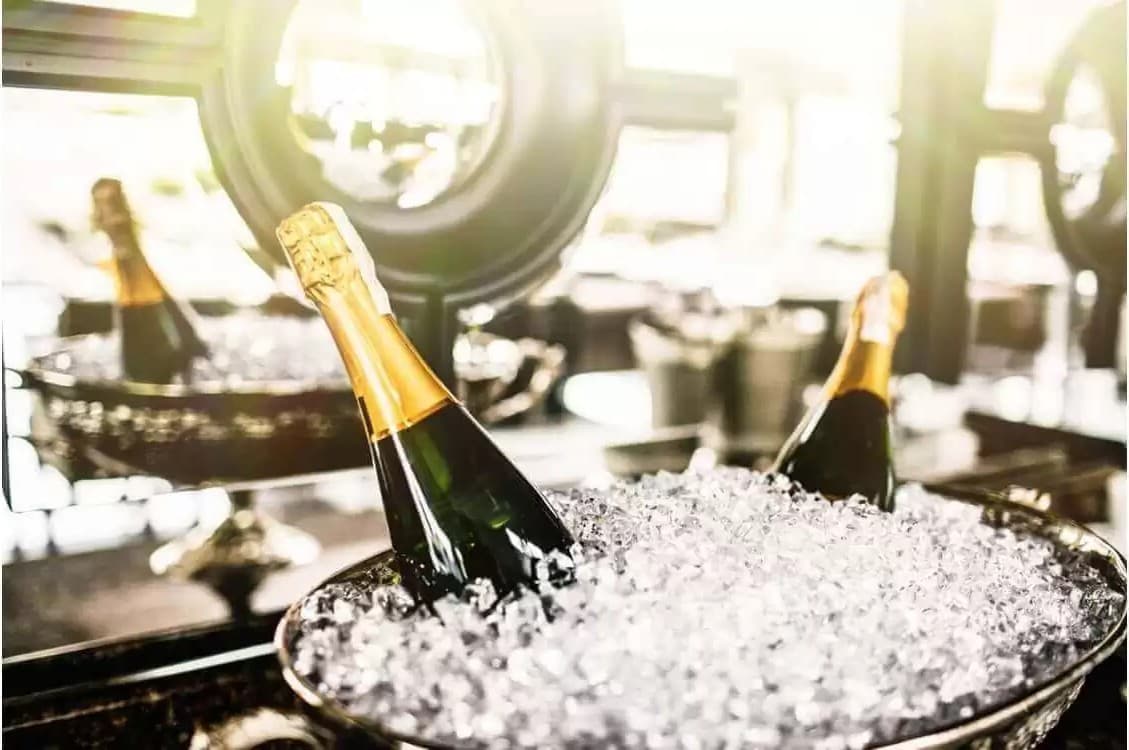
If you’re planning an aperitif, a meal or a tasting, simply place the bottle(s) in the fridge an hour before opening them. During that hour, you can place the bottle in a bucket half-filled with water and half-filled with ice cubes. If you have less time to chill your bottle, still place it in a bucket half-filled with water and half-filled with ice cubes, and add a generous handful of fine salt to cool it down more quickly. Please note: never put a bottle in the freezer. Ideally, a young, non-vintage brut champagne should be served as an aperitif at between 6 and 9°, but not too cold, so as not to distort the aromas. Serve between 10 and 12° for a vintage champagne that has been aged longer, or for serving with a meal.
3. IN WHAT GLASS SHOULD CHAMPAGNE BE SERVED?
There are several schools of thought on this subject. Pierre-Emmanuel Taittinger, of the eponymous house, advocates the coupe favoured by Marie-Antoinette, for which one of her breasts is even said to have served as a model. The flute, which accelerates the rise of the bubbles and thus the effervescence, remains synonymous with festivities and celebrations. Cellar masters and oenologists tend to prefer the tasting glass, or tulip glass. A wine glass, with a wider rim than a flute, allows the aromas to be better appreciated. Various chefs (Arnaud Lallement) and sommeliers (Philippe Jamesse) have designed ranges of glasses suited to different tasting styles. The differences can sometimes be striking, so the best thing is to try them out during a fun tasting session.
4. HOW SHOULD CHAMPAGNE BE SERVED?
A loud ‘pop’ or not? It all depends on the context of the tasting. A gourmet ritual calls for opening the bottle discreetly. A celebration calls for the famous joyful ‘pop’, bringing smiles and sparkling eyes. Once opened, the bottle must be held by the base and never by the neck. The idea is to pour the champagne gently and not to fill the glass to the brim. It is recommended to stop at two-thirds full, at most.
5. HOW SHOULD YOU TASTE CHAMPAGNE?
We could provide you with a very technical guide to tasting. However, it’s actually quite simple: it’s all about taking your time and listening to your senses. Your sense of hearing is already engaged by the ‘pop’ and the melody of the bubbles as they’re poured into the glass. Next, take a moment to observe the colour of the Champagne and how it holds its shape in the glass. Take a sniff, try to identify the aromas that rise from it, then take a sip. First one, then another, just to let the sensation of the bubbles fade so the flavours can come through. And share your thoughts. We’re talking here about taking pleasure in the tasting; there’s no quiz at the end, just sharing. So, enjoy!
Ideally, if you have a small budget to spare, you could invest in a home wine cooler. These come in a range of models to suit all budgets and are now highly effective. They can perfectly replicate the humidity, temperature and light levels normally found in a wine cellar.
If you don’t have the budget or space for a home wine cooler, you can store your bottles in a garage; this will protect your wine from light and often offers fairly cool temperatures, ideal for storing wine.
A third option is a room or cupboard specially fitted out for wine storage. To do this, you’ll need to ensure the ideal conditions (temperature, light, humidity, bottle positioning, etc.) are strictly maintained so as not to spoil the wine.
Finally, as a last resort, you can store your wine in a fridge. Generally speaking, only use a fridge when you are about to drink the wine, or if the wine has been opened and needs to be kept until the following day. Also, be sure to take the bottle out of the fridge to allow it to warm up and reach its serving temperature (around 10 degrees for white wine and 15–17 degrees for red wine).
Champagne should be stored at a relatively low temperature. However, if you don’t have a wine cellar, you’ll need to remember to chill your champagne in the fridge when you plan to drink it. In this case, you should keep it in the fridge for between 2 and 4 hours.
Champagne is a delicate wine; you should avoid sudden temperature changes and, above all, do not store it at high temperatures (20°C and above).
Whilst biodynamic champagne is produced using esoteric methods, and organic champagne does not use synthetic products or chemical ingredients, what about natural champagne? Natural champagne comes from vines grown without the use of chemicals, and no additives are used in the winemaking process. However, there is a limit to be observed: sulphur dioxide (SO₂) must not exceed 30 mg per litre. Natural Champagne may be produced using organic or biodynamic farming methods, but no winemaking additives (apart from SO2) are used.