
On parle souvent de l’expérience du champagne comme d’un art à part entière. Mais ce qui frappe vraiment, c’est ce...


Champagne is much more than just a sparkling wine; it's a symbol of celebration, elegance and French savoir-faire. Yet, faced with the countless bottles lining the shelves, one question often comes up: how do you distinguish an exceptional cuvée from a mediocre wine? While it's easy to be seduced by a prestigious label, true quality lies in the technical and sensory details. Here are the keys to tasting like a pro.
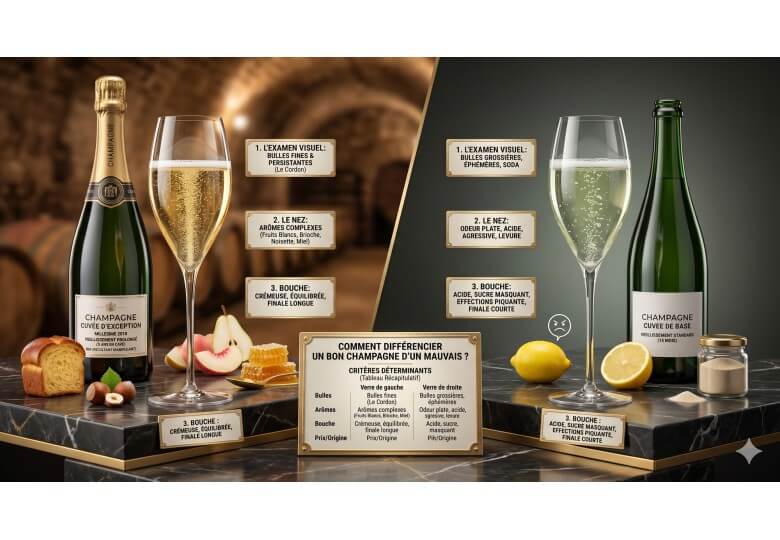
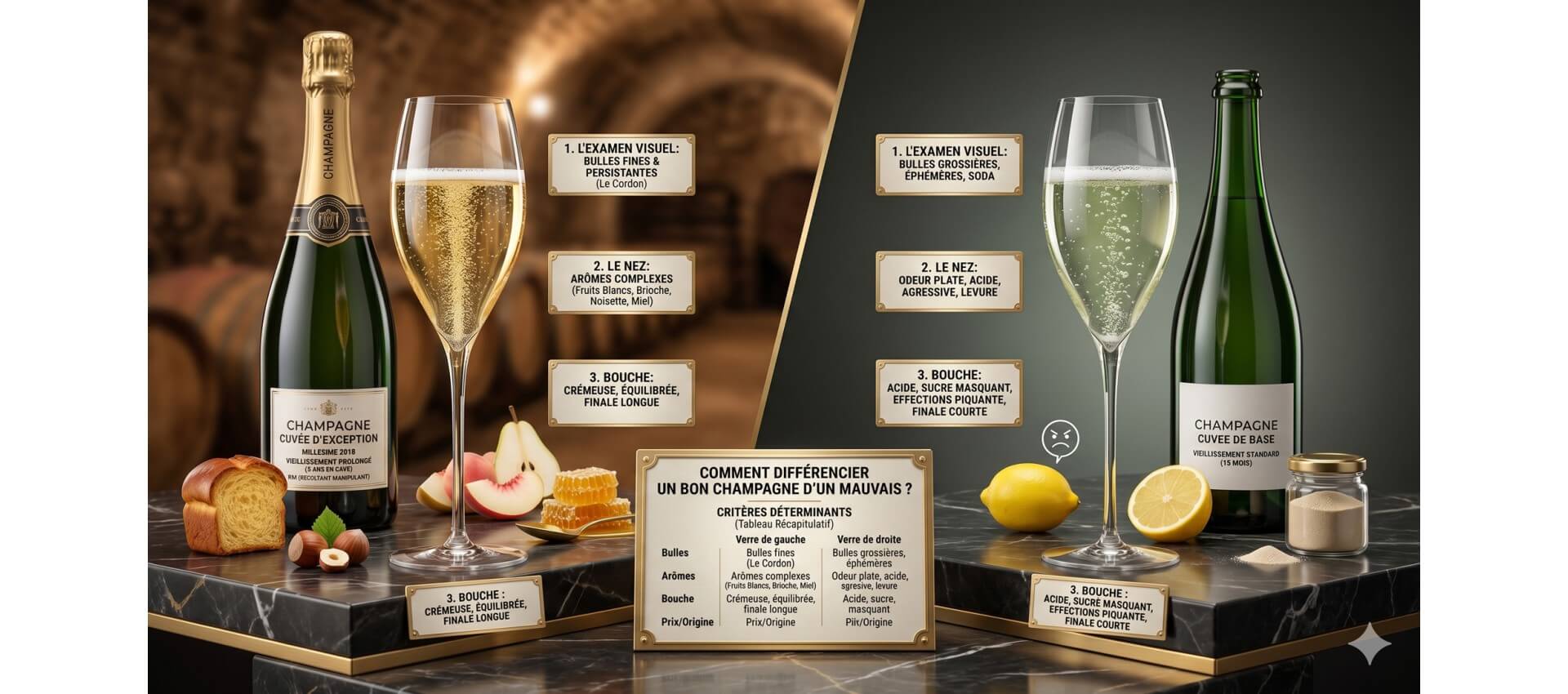
1. Visual examination: the finesse of the bubbles
Contrary to popular belief, it's not the quantity of bubbles that determines quality, but their finesse and behavior.
Good Champagne: Bubbles are tiny, persistent and rise in regular columns (the famous "cordon"). Fine bubbles are a sign of slow foaming and prolonged cellar ageing.
Bad Champagne: Coarse, soda-like bubbles that disappear in seconds. This often betrays artificial carbonation or a wine that is too young.
2. The nose: complex aromas
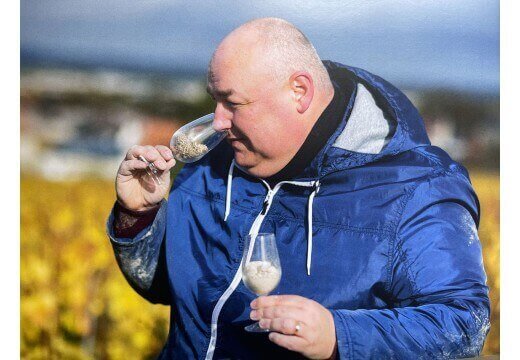
A good Champagne should tell a story right from the first nose. Bring your glass close to you (without swirling it too vigorously so as not to lose the gas) and inhale.
A good Champagne offers a rich palette of aromas. There are notes of white fruit andcitrus, as well as evolutionary aromas such as toasted brioche, hazelnut and honey.
Bad Champagne: It smells flat, sometimes acidic or aggressive. An overly pronounced yeasty odor or, conversely, a total absence of perfume are signs of poor workmanship.
3. Mise en bouche: the perfect balance
This is the ultimate stage. A great wine is defined by its harmony.
The attack: It must be frank and lively, without being aggressive.
Texture: We're looking for a "creamy" mouthfeel. The effervescence must be integrated into the wine and not give the impression of stinging the tongue.
Length: A good Champagne has a "long finish". The taste lingers for several seconds after swallowing.
Did you know? Champagne that is too green (acidic) or too sweet often masks inferior grapes or a lack of ripeness.
Become an expert on Champagne terroir
It's sometimes difficult to put your sensations into words without a little practice. To move from theory to practice and learn to detect all the subtleties of the grape varieties (Chardonnay, Pinot Noir, Meunier), nothing beats experience in the field.
To refine your palate, you can take part in a oenology course in Champagne with Sport-Decouverte.com . Accompanied by experts, you'll learn how to decipher labels, understand the importance of dosage and recognize the specificities of the appellation's different zones.
4. The importance of the label
A few visual clues on the bottle can put you on the right track:
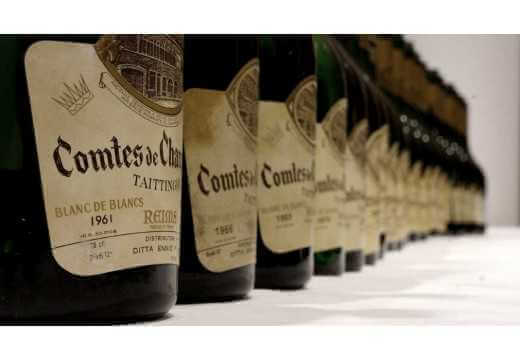
Ageing time: A non-vintage Champagne should be aged for at least 15 months. Great vintages often exceed 3 years.
Harvest information: look for "RM" (Récoltant Manipulant) labels, which guarantee that the winemaker grows his own vines and makes his own wine.
In conclusion, while taste is subjective, the technical quality of a Champagne is not. By observing the bubbles, analyzing the aromas and checking the provenance, you'll never choose your bottle at random again!