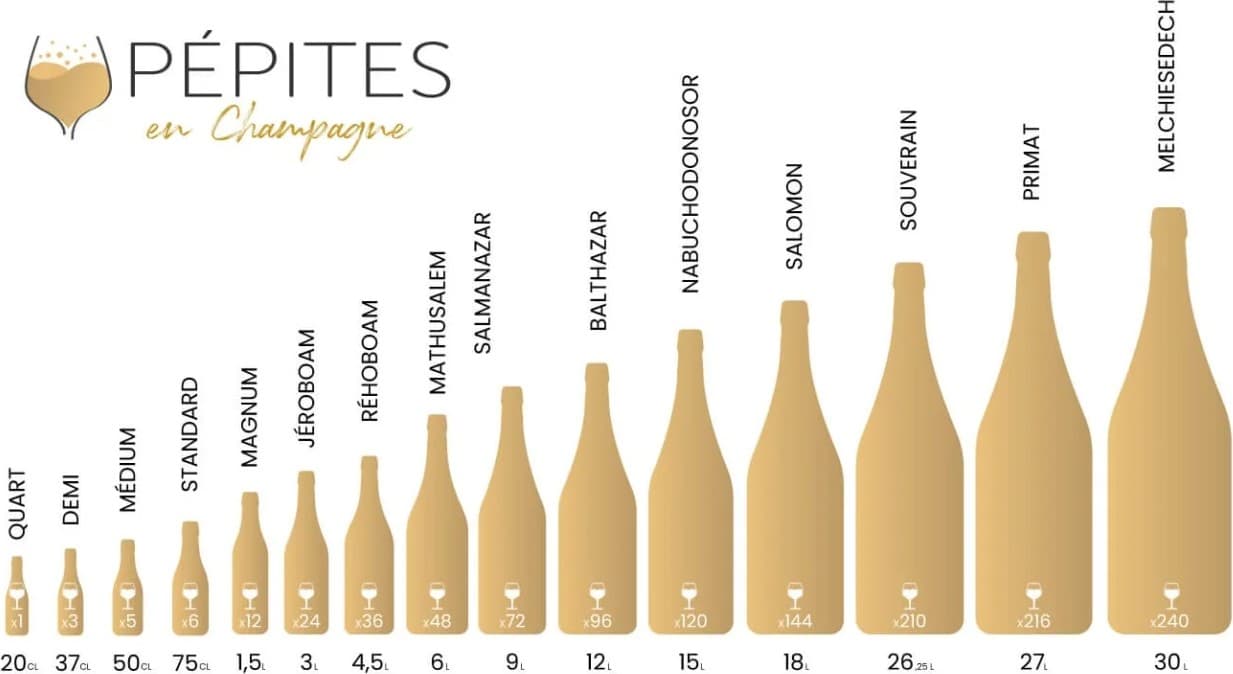
From the quarter bottle of 20 cl, served as an individual portion, to the 30-litre Melchizedek, which weighs more than a child, champagne comes in a dozen different formats. The most common are the half-bottle, the 75 cl bottle and the magnum; beyond that come the large formats, which champagne houses reserve for celebrations and large gatherings. The table below summarises the capacities, the bottle equivalent and the number of 12.5 cl flutes each format can serve.
| Format |
Capacity |
Bottle equivalent |
Number of flutes |
Serving temperature |
Main characteristics |
| The Quarter |
20 cl |
1/4 |
1.5 to 2 |
8-13°C |
Individual portion |
| The Half-bottle |
37.5 cl |
1/2 |
3 to 4 |
8-13°C |
Ideal for two |
| The Classic |
75 cl |
1 |
5 to 6 |
8-13°C |
Standard, keeps for 3-5 years |
| The Magnum |
1.5 L |
2 |
10 to 12 |
8-13°C |
The best format for ageing |
| The Jeroboam |
3 L |
4 |
20 to 24 |
8-13°C |
Second fermentation in the bottle |
| The Rehoboam |
4.5 L |
6 |
30 to 36 |
8-13°C |
Festive, slow maturation |
| The Methuselah |
6 L |
8 |
40 to 48 |
8-13°C |
Long, harmonious ageing |
The magnum: 1.5 litres, the cellar masters' favourite format
A magnum contains 1.5 litres, the equivalent of two bottles, and serves around a dozen flutes. With an identical neck and cork, it holds twice as much wine for the same surface area in contact with the air: the champagne evolves more slowly and keeps its freshness for longer. It is the ideal format for a dinner for six to eight people. Our champagne magnums and jeroboams are grouped together in a single selection, and our guide explains which champagne magnum to choose.
The jeroboam: how many litres?
In Champagne, a jeroboam contains 3 litres, the equivalent of four bottles or two magnums. It serves around 24 flutes of 12.5 cl: enough for an aperitif for twenty people. Note that the name does not refer to the same capacity everywhere: in Bordeaux, a jeroboam contains 5 litres. Like most large formats, it is named after a king of the Old Testament — Jeroboam, the first king of the kingdom of Israel.
A jeroboam requires a little organisation: chill it the day before, lying down, then serve it in a large bucket filled with ice and water. It is served with both hands, the dominant hand under the base of the bottle, pouring slowly. In our cellar, the Deutz Brut Classic jeroboam and the Taittinger Brut Prestige jeroboam make a real impression at the table.
Beyond the jeroboam: the very large formats
After the jeroboam come the rehoboam (4.5 litres, 6 bottles) and the methuselah (6 litres, 8 bottles), followed by bottles rarely seen outside large receptions:
- Salmanazar: 9 litres, or 12 bottles;
- Balthazar: 12 litres, or 16 bottles;
- Nebuchadnezzar: 15 litres, or 20 bottles;
- Solomon: 18 litres, or 24 bottles;
- Primat: 27 litres, or 36 bottles;
- Melchizedek: 30 litres, or 40 bottles.
These very large formats are produced in small quantities by only a few champagne houses, often made to order. For a wedding or a large celebration, several magnums or a jeroboam remain easier to serve and keep cool; our article on how many bottles of champagne for a wedding helps you work out the right quantity.