Get a €40 discount on purchases of €600 or more, and a €100 discount on purchases of €1,200 or more of champagne on participating items (excluding shipping costs)
Get a €40 discount on purchases of €600 or more, and a €100 discount on purchases of €1,200 or more of champagne on participating items (excluding shipping costs)
The best winemaker-produced champagnes of 2026: 26 producers to watch, ranging from €22 to €190
The essentials
A ‘vigneron’ champagne (récoltant-manipulant, or ‘RM’ on the label) is produced by the person who grows the grapes. Our 2026 selection, by region: Côte des Blancs — Agrapart, Larmandier-Bernier, De Sousa, Éléonore, Lancelot, Rutat, Walraet; Montagne de Reims — Egly-Ouriet, Arnaud Moreau, Delavenne, Péhu Simonet, Vignon, Texier, Léclapart, Gounel-Lassalle, Lamiable; Vallée de la Marne — Leclerc Briant, Françoise Bedel, Courtois, Geoffroy, Choppin, Taillet, Néret-Vély, Mignon-Boulard, Jestin, A. Bergère; Côte des Bar — Fleury, De Lozey. From €22 (Courtois Brut) to €210 (Lamiable Hélios).
What is a ‘vigneron’ champagne?
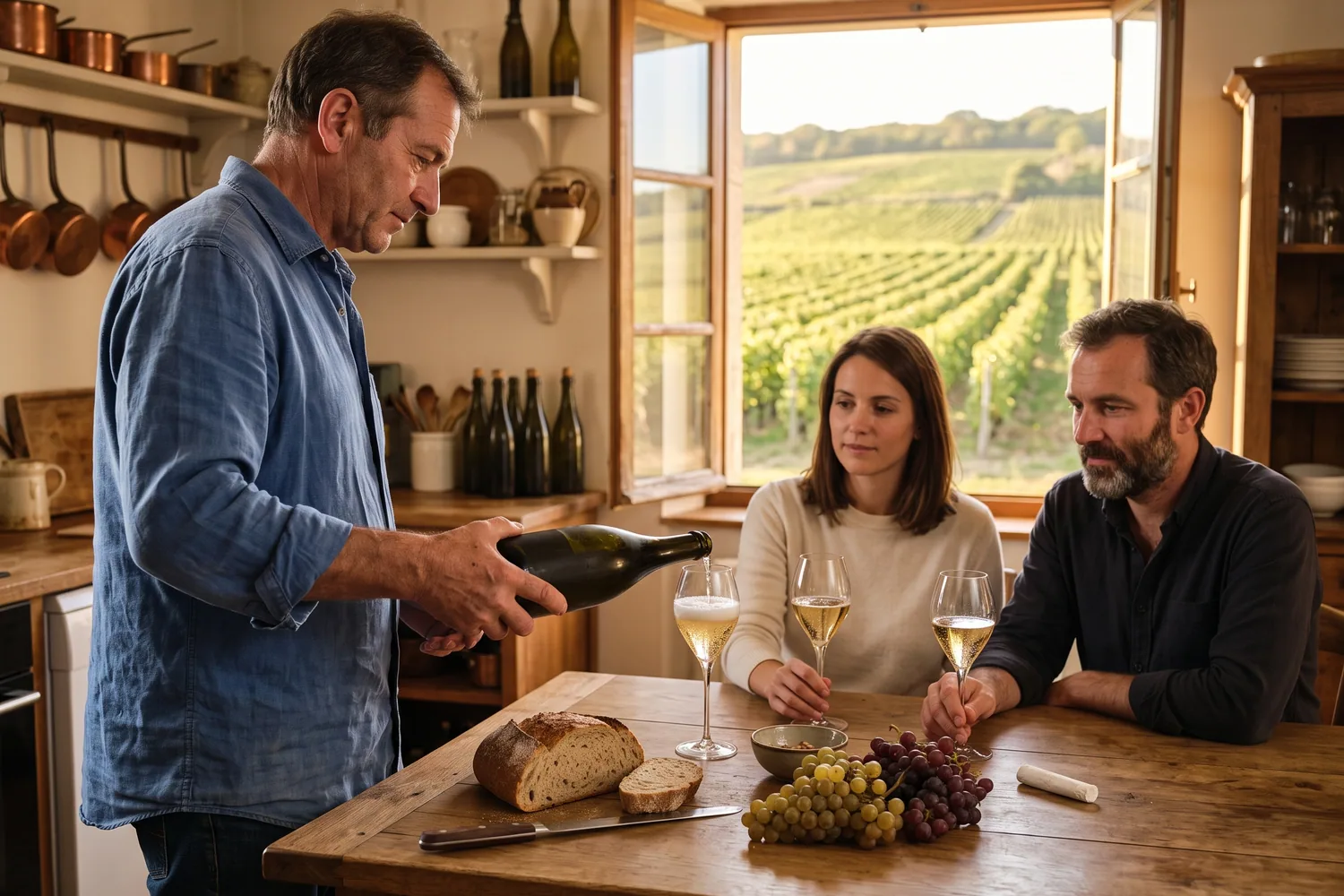
A champagne produced by the winegrower who cultivates the grapes: on the label, the initials RM (récoltant-manipulant) appear in small print. This is in contrast to NM (négociant-manipulant, the houses that buy all or part of their grapes) and CM (co-operative). Around 2,000 winegrowers sell their own champagne.
Is a champagne from a small producer better than one from a major house?
It is different: more distinctly characterised by its village and vintage, less smoothed out by blending, often lower in sugar content — and, for the same quality, cheaper, because there are no marketing or distribution costs. The finest winemakers (Agrapart, Egly-Ouriet, Léclapart, Larmandier-Bernier) are now just as sought-after as the prestigious vintages from the major houses.
How much does a good winemaker’s champagne cost?
Between €22 and €40 for a quality brut (Courtois, Delavenne, Rutat, Taillet, Néret-Vély, Péhu Simonet), €40 to €70 for grands crus and single-vineyard cuvées (Agrapart, De Sousa, Arnaud Moreau, Geoffroy), and between €80 and €200 for cult cuvées (Egly-Ouriet, Léclapart, Larmandier-Bernier, Jestin, Lamiable).
Who are the best winemakers in Champagne?
Those whose wines are sold at the same price as, or higher than, the major houses: Egly-Ouriet in Ambonnay, Agrapart in Avize, Larmandier-Bernier in Vertus, David Léclapart in Trépail, Leclerc Briant in Épernay, Jestin, Françoise Bedel. All are in our cellar — but our selection also includes twenty lesser-known winemakers, at half the price, who are the very reason Pépites exists.
How do you buy a winemaker’s champagne?
Either directly from the estate, or from a wine merchant who selects them — this has been our speciality from the very beginning: every winegrower on this list has been tasted, visited and monitored vintage after vintage. Our vintners’ champagnes are grouped in the ‘récoltants-manipulants’ category and are delivered throughout France and Europe.
A ‘vintner’s champagne’ is a champagne where the person who pruned the vines has also signed the bottle. There are several thousand of these in Champagne; around thirty have found their way into our cellar, and not by chance. Here is our 2026 selection, region by region, with the cuvée to start with and its price for each one.
5 min read
There are two kinds of Champagne. There is that of the major houses, which buy their grapes from thousands of winegrowers and even out the variations between vintages through blending; and the one made by winegrowers who keep their own grapes, make the wine themselves and put their name on the bottle — RM, récoltant-manipulant, in small print on the label. It is this kind of Champagne that inspired us to create Pépites. Here is our 2026 selection: twenty-six producers, region by region, with for each one the cuvée to start with and its price in our cellar. To understand the difference between this and a ‘house’, read first ‘grand maison’ or ‘vintner’s Champagne ’; to spot the RM on a bottle, read ‘how to read a label’.
Côte des Blancs: Chardonnay on chalk
South of Épernay, a slope of pure chalk and grand cru villages — Avize, Cramant, Oger, Le Mesnil — where Chardonnay produces the world’s most refined blancs de blancs. Pascal Agrapart, in Avize, is one of Champagne’s most admired winemakers; his Extra Brut 7 Crus (€55.80) is the perfect introduction. Larmandier-Bernier, in Vertus, a global benchmark for biodynamic winemaking: Latitude (€57.50). De Sousa Réserve (€46), in Avize, a biodynamic Chardonnay grand cru. Éléonore Gageure 22 (€38.70), from the Dzieciuck estate in Oger, one of our favourites. Philippe Lancelot Les Hauts d’Épernay 2018 (€60), in Chouilly. And three blancs de blancs for under €30 that defy the prices typically seen on the Côte: René Rutat (€28.50) and Michel Rutat Lignum (€42.30) from Vertus, Walraet (€27.76) from Cramant, and Gonet Sulcova (€23.35). All our blancs de blancs are listed here.
Montagne de Reims: the Pinot Noir of the grands crus
Two hours to the south lies the Aube department and its Côte des Bar, long regarded as the ‘suburbs’ of Champagne, but now its experimental ground. Fleury Boléro 2008 Extra Brut (€98), Champagne’s first biodynamic house, established in 1989; and De Lozey Cuvée 50-50 (€68.40), in Celles-sur-Ource, since 1881.
How to choose from twenty-six winemakers
To try: Courtois Brut, Delavenne Dom Basle, René Rutat Blanc de Blancs — three bottles, three regions, all under €30 each. For a blanc de blancs: Walraet, Éléonore, De Sousa, then Agrapart. For a Pinot Noir: Arnaud Moreau, Péhu Simonet, then Egly-Ouriet. For organic: Leclerc Briant, Bedel, Larmandier-Bernier, Léclapart — see our top organic champagnes. For your cellar: Lamiable Hélios, Jestin 2010, Fleury Boléro 2008. All are featured in our ‘récoltants-manipulants’ category, and this season’s favourites in our ‘hidden gems’ section. To understand what happens between the vineyard and the bottle, read our article on the Champagne method.
Serving and storage
Winemakers’ champagnes are often less sweetened and more wine-like than house bruts: serve them at 9–10 °C in a white wine glass rather than a flute. Bruts are best enjoyed within three years; grands crus and single-vineyard cuvées will improve over five to ten years, stored horizontally in the dark at 10–12 °C. The prices quoted are those recorded in our cellar on the date of publication; as these winemakers produce small quantities, several cuvées are available in limited numbers.