The Champagne house is launching a pioneering initiative: it has created a series of videos in French sign language, in order to share its passion and its profession with deaf and hard of hearing people, and thus make Champagne more inclusive.
A family house that shows the way to a more accessible Champagne
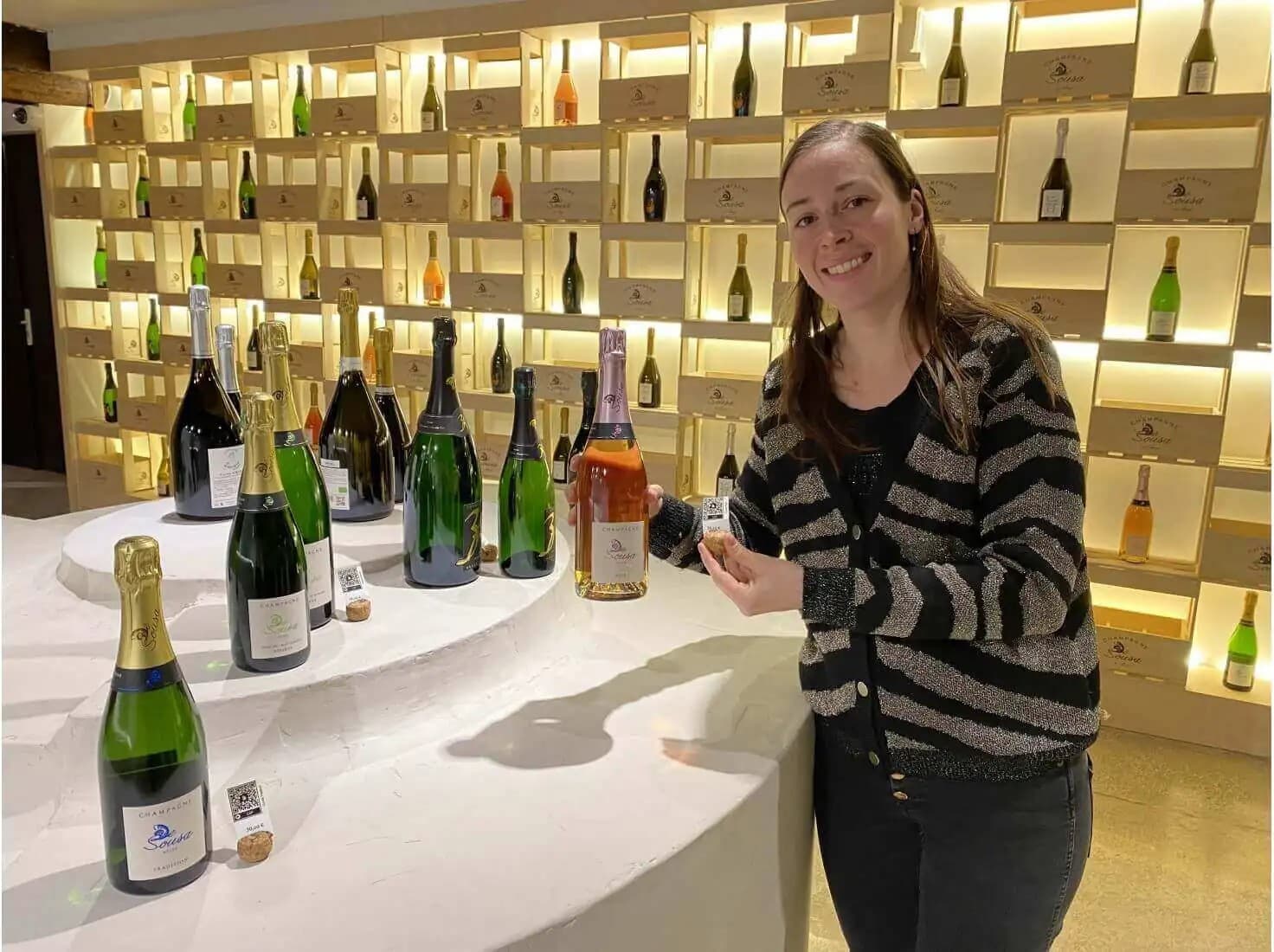
The house De Sousa was founded in the early 1950s in Avize, in the heart of the Côte des Blancs. The 10 hectare estate is now managed by the three children Julie, Valentin and Charlotte (taken over in 2020).
It is the latter who had the idea to create videos translated into sign language, in order to make his expertise and passion more accessible to the Deaf community.
Accompanied by the adapted company LÉA de Champagne, the house De Sousa has created a series of ten short videos translated into LSF, which presents its vintages, its approach, its methods and its history.
However, this is only the beginning: the Champagne house wishes to organize, from summer 2022, cellar visits in sign language. To achieve this goal, its team is currently training in sign language with the Association of the Deaf of Reims and Champagne-Ardenne.
/videos/01-Histoire-de-la-maison.mp4#t=3.2
Cuvées that reflect an exceptional terroir
Located on the most beautiful terroirs of Champagne, the house De Sousa produces about 100 000 bottles of Champagne per year. It offers several cuvées, including Brut Tradition, Extra-Brut Réserve, Brut Rosé, Mycorhize, Umami, 3A and Cuvée des Caudalies.
Its vineyards have a chalky subsoil that gives its champagnes finesse, elegance and minerality.
Three quarters of his vines are over 45 years old. Its champagnes feature three grape varieties: chardonnay (60%), pinot noir (30%) and pinot meunier (10%). Since the 1995 vintage and on the old vines, the vinification is done in small oak barrels, which gives fatness to the wine. Each vintage matures slowly in the cellar dug in the chalk of Champagne, which has a constant temperature of 10°C.
/videos/02-Vinification.mp4#t=3.4
An organic and biodynamic champagne
The family De Sousa produces its champagne with respect for the land, love of work well done, quality and innovation.
Under the direction of Erick De Sousa, the house has gradually converted to organic and biodynamic farming. "I have never been very comfortable with chemicals," explains Erick De Sousa. "For me, organic is not a religion, but a tool to improve quality.
The Champagnes de Sousa are certified organic since 2010 and biodynamic since 2013. The biodynamic approach differs from organic: it is more complex, because it takes into account the entire universe of the vine.
/videos/03-Certifications%20Biologique%20et%20Biodynamique.mp4#t=3.7
History of the Champagne House De Sousa
If the family De Sousa settled in Champagne, it is because Manuel De Sousa fought alongside the Allies during the First World War. Originally from the province of Braga, near Porto, he made contacts in France, before joining his wife and son Antoine, who remained in the country.

As a farm worker, Manuel rented out his arms and spread the good yellow soil, rich in iron, that was dug up in the Avize woods, on the vineyards. At the age of 29, he died of a brain tumor, leaving behind a wife and four children.
Antoine, the eldest, had a decisive encounter: he fell in love with Miss Zoémie née Bonville, who came from a well-established family of winegrowers in Champagne.
CHAMPAGNE CUVÉE 3A
/videos/08-Cuvee-3A.mp4#t=3.2
CHAMPAGNE RESERVE GRAND CRU
/videos/05-Cuvee-Reserve.mp4#t=3.4