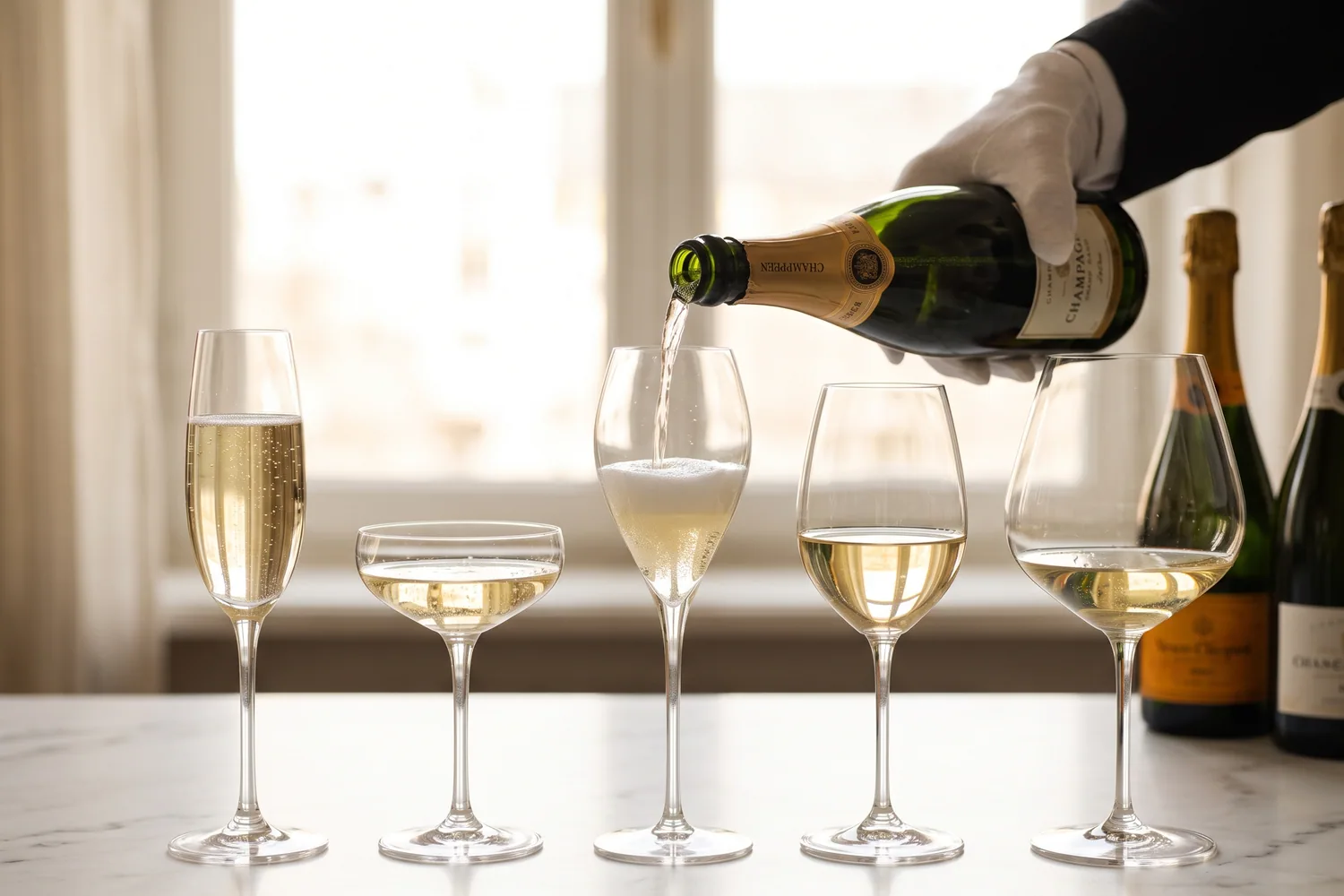
The same champagne, served in two different glasses, tells a different story. The flute creates an elegant stream of bubbles but traps the aromas; the coupe releases them but loses its effervescence within a few minutes; the wine glass brings out notes of brioche, fruit and flowers that you’d never noticed before. This guide explains what each shape changes, which glass to choose depending on the champagne, and how to serve it.
What the glass really changes
Three things. The bubbles: they form at the ‘point de mousse’ engraved at the base of the bowl and rise all the more evenly the narrower and taller the glass is. The aromas: they need a surface area in contact with the air and space to concentrate — a wide bowl that tapers towards the top. Temperature: a thin glass, held by the stem, keeps the champagne cool; a thick glass, held in the palm of the hand, warms it up in a matter of minutes. The ideal glass strikes a balance between the three.
The flute: bubbles above all else
Tall, slender and elegant, the flute showcases the effervescence and keeps the champagne chilled. Its drawback: it stifles the nose, and a great champagne remains muted in it. It is best suited to young, lively brut champagnes, as an aperitif, or for numerous toasts where glasses are refilled quickly and where one looks at the drink as much as one drinks it.
The coupe: charm and its limitations
Wide and shallow, the coupe was the glass of choice for 19th-century celebrations and the Roaring Twenties — the story of Marie-Antoinette is just a myth. It releases the aromas but exposes a large surface area to the air: the bubbles escape within a few minutes and the wine warms up. Nowadays, it’s reserved for champagne cocktails and pyramids of coupes — see our cocktail recipes. Our ‘coupe or flute’ page settles the debate in detail.
The tulip glass: the wine merchants’ compromise
A bulbous bowl that tapers towards a narrower rim: the tulip glass retains the bubbles like a flute and concentrates the aromas like a wine glass. It is the ultimate all-rounder, perfect for a grand cru brut, a blanc de blancs or a rosé, whether served with a meal or as an aperitif.
The white wine glass: the sommeliers’ choice
Champagne is, first and foremost, a wine, and sommeliers are increasingly serving it in a white wine glass: a wide bowl, a slightly tapered rim and thin sides. The loss of bubbles is minimal; the gain in aroma is immense, especially for cuvées aged in oak or rich in reserve wines — such as a Bollinger Special Cuvée or a Krug Grande Cuvée. If you had to keep just one glass, this is the one.
The Burgundy glass: for great vintage champagnes
Even wider still, the Burgundy glass is designed for age-worthy champagnes and prestige cuvées: a Dom Pérignon Plénitude P2, a Bollinger R.D., or an old Krug Vintage, served at around 12 °C, reveal notes of honey, dried fruit and spices. For a young brut, it’s too large: the wine gets lost in it.
Which glass for which champagne?
| Champagne | Recommended glass | Temperature |
|---|
| Young non-vintage brut, aperitif, toasts | Flute or tulip glass | 8 to 10 °C |
| Blanc de blancs, rosé | Tulip-shaped glass or white wine glass | 8 to 10 °C |
| Brut from a prestigious house, aged in oak; reserve wines | White wine glass | 10 to 12 °C |
| Vintage, prestige cuvée | White wine or Burgundy glass | 10 to 12 °C |
| Old vintage, late disgorgement | Burgundy glass | 12 °C |
| Champagne cocktail | Flute | very chilled |
When choosing a bottle, our Blanc de Blancs, our vintage champagnes and our entire range of champagnes.
Serving it properly, whatever the glass
- A clean glass, free from any traces of washing-up liquid: even the slightest greasy film will kill the bubbles. Rinse with clean water and dry with a lint-free cloth.
- Fill to a third, in two stages, holding the glass at a slight angle, to allow the foam to settle and the aromas to concentrate.
- Hold the glass by the stem or the base of the stem — never by the bowl. Our article on the art of holding a glass of champagne explains the technique in detail.
- The right temperature: 8 to 10 °C for a brut, 10 to 12 °C for a vintage — our storage and serving advice, and how to chill a bottle quickly.
- The ‘point de mousse ’: an engraving at the base of the glass causes the bubbles to rise in a cord-like stream; a new glass without a ‘point de mousse’ can make the champagne seem flat.
Mistakes that spoil a good champagne
A glass frozen in the freezer: it frosts up, obscures the colour and breaks the head of foam on first contact — a glass at room temperature is sufficient; it is the wine that must be cold. A glass filled to the brim: no room for the aromas, and the wine warms up before it is drunk. Plastic glasses used at receptions: the bubbles don’t cling to them properly and the bouquet is lost; for the same price, a cheap glass white wine glass works better than a plastic flute. Finally, glasses that have absorbed odours from a tea towel or cupboard: always rinse with clean water before serving, and smell the empty glass — if you can smell anything, the champagne will too.
Crystal or ordinary glass?
Crystal does not improve the wine, but the delicacy of its walls and rim alters the sensation on the palate and the precision of the pour; a thin, light, mouth-blown glass is a real pleasure. For leading crystal glassware brands, our article on the perfect glass for champagne features a selection. And for what happens next in the glass, read how to taste champagne — not forgetting the calories in a glass, as this question always comes up at Christmas.