
Geoffrey Orban - Revealing the DNA of Champagne's subsoils and future wines
The essentials
Geoffrey Orban, a Reims-based specialist in Champagne terroirs, analyses the subsoil at the soil pit using a multidisciplinary sensory approach (geology, soil science, oenology, etc.). When the root system is well developed in the subsoil, the distinctive character of the wines reflects that of the deep layers being explored.
- How does Geoffrey Orban analyse the subsoil in the Champagne region?
- Geoffrey Orban takes samples from each subsoil layer, examines them visually and by touch (texture, structure, moisture content), then places them in a glass to smell them. He adds water to speed up the release of aromatic compounds into the aqueous solution.
- Can you tell a winemaker’s viticultural practices by tasting a champagne?
- According to Geoffrey Orban, the intrinsic freshness of the wines, the type of salinity and the aromatic character of the rocks during tasting reveal the condition of the root system and the underground environment, and provide insight into the extent of the producer’s oenological intervention.
- Which Champagne winegrowers have called on Geoffrey Orban?
- Among the Champagne winegrowers who approached Geoffrey Orban were Pertois-Lebrun in Cramant, Champagne Rémy Lequeux in Passy-sur-Marne, Benoit Venu in Fossoy and Arnaud Gounel in Chigny-les-Roses, to understand the link between their plots and their cuvées.
Drawing on geology, soil science and sensory tasting, Geoffrey Orban reveals what the Champagne subsoil tells us about future Champagne wines.
5 min read
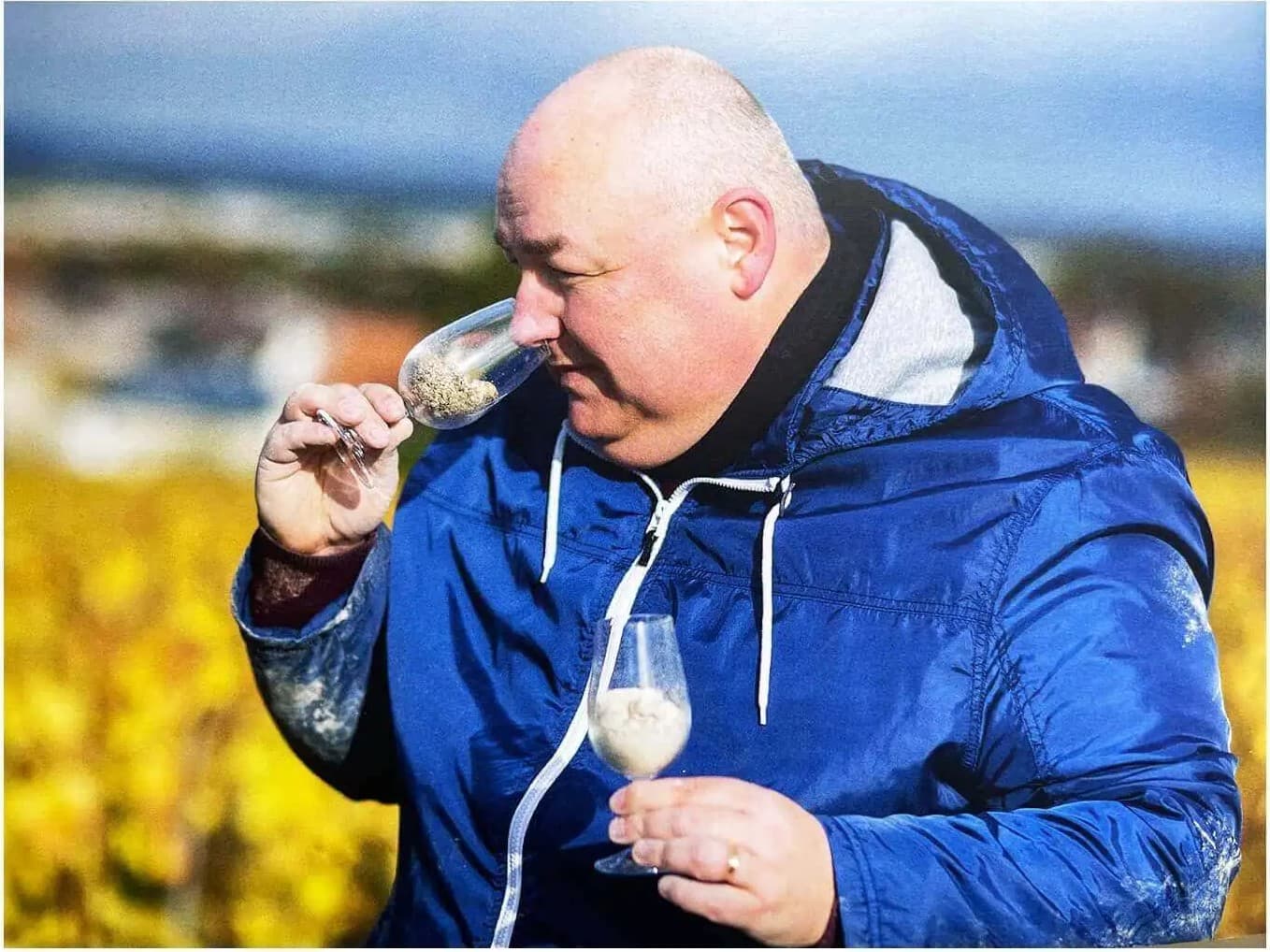
A specialist in the terroirs of Champagne, Geoffrey Orban from the Rémois region works with winegrowers in the vineyards, at the foot of pedological pits. His tactile and olfactory analysis of several subsoil horizons delivers a precise diagnosis.
Root location and underground life tell us a great deal about the profile of future wines.
Geoffrey, you're often referred to as "The man who tastes the earth". Does this shortcut irritate you ?
Not because I do it, yes because my analysis calls on (cartography, multidisciplinary knowledge of geology, physical geography, microtoponymy, regional history, paleontology, entomology, pedology, microbiology, plant anatomy and physiology, cell signalling, viticulture, oenology, sommellerie). But I remain discreet.
My approach is scientific, based as it is on a hypothesis, a method and a rich, reproducible experiment. I lack the characterization of rock-wine tracers, but I have the protocol. All I need is a lab and funding, and I'm off on my crusade! What's more, the objectives are varied: choosing the parcel or parcels to start manipulating, understanding a parcel that is used in several blending cuvées, making the link between the parcel and its environment, and so on champagne wine, the analysis also leads to the proposal of a winemaking itinerary that would best support the sensory typicity of the plot. The analysis also leads us to propose a winemaking itinerary that would best support the sensory typicity of the plot.
What are the key stages in your expertise ?
Beforehand, the cadastral numbers of the plots allow me to understand the influences of the area.
But the blank page is in the pit. Discussions with the winemaker, reading the landscape, observing the different layers and the root profile provide a lot of information. Then I take samples from all the horizons, as close as possible to the roots, with several samples in some cases.
I then carry out a visual and tactile analysis of the samples (texture, structure, humidity...).
The tasting arrives.
It consists of placing samples of each horizon in a glass, smelling them and then adding water to accelerate the addition of aromatic elements to the aqueous solution.
It requires concentration, but is open to everyone. I used to taste everything, but now I do if I don't have the information. Then there's the "digestion" of information, taking a step back and writing up a dossier for the winemaker.
 |
|

I carry out a visual and tactile analysis of the samples (texture, structure, humidity...).
Tasting involves placing samples of each horizon in a glass, smelling them and then adding water to accelerate the addition of aromatic elements to the aqueous solution.
What did you learn from this particular tasting?
There's so much to say, I could write a book! First of all, the sensory characterization of the crus de la Champagne, there are differences, notably in wine concentration, redox potential (editor's note: indicator of the vitality of a living environment) and potential for evolution over time. There's also the typicality of grape varieties by type of soil or rock.
And then come the smells of the earth and rocks: orange, tangerine, kiwi, bell pepper, lemon, lemongrass, split pea, lentil, blackcurrant, pepper, almond, pistachio, legume, white fruit, yellow fruit, metallic, and so on. With their distinctive tastes and tactile typicities, which form the basis of my thinking on geo-sensory tasting, which I use for all the wines and rocks I've tasted in France and elsewhere.
Now the truth lies elsewhere.
It's high time we took a closer look at the metabolisms and underground exchanges that interact with and condition the typicity of wines. When the root system is well developed underground, we always find that the sensory typicity of the wines echoes that of the deepest, least nutritious layers explored. Tasting also confirms the evolution of cultivation practices: plant-based tillage that respects underground balances, better knowledge of diseases, constant monitoring of vines...").
When you taste champagne, do you notice the winemaker's cultivation practices ?
The results of these practices can be appreciated by tasting, even without expertise. The intrinsic freshness of the wines, the type of salinity, the typicity and the tactile and aromatic vibration of the rocks are good indicators. The more these sensations assert themselves, the more you know about the root system and underground life. And the more you know that producer doesn't mask them with too much oenological interventionism (which isn't bad in itself, but offers other tasting perspectives).
Can you name a fewwinegrowers who approached you ?
Ires recently, Antoine and Clément Bouret from Champagne Pertois-Lebrun in Cramant.
I was also lucky enough to taste the wines of Pascal Lejeune in Moussy, Champagne Rémy Lequeux in Passy-sur-Marne, Benoit Venu in Fossoy, Francis Orban in Leuvrigny. Arnaud Gounel at Chigny-les-Roses, Edouard Duval at Bligny or Phlippe Lancelot in Cramant.

"Nature is stronger than we are |
Text: Thierry Perardelle - Photos: Frédéric Leroux
Our best sellers
À lire également
Champagne as a corporate gift: budget, bottles and rules — the 2026 guide
Champagne is the corporate gift that needs no explaining: it evokes celebration, France and thoughtfulness, without ever being in poor taste. However, you still need to choose the right budget, the right bottle and stick to the rules. Here is our 2026 guide: how much to budget per person, the gift sets that are always a hit, gifts that make an impression, the menu, tax implications and delivery.
The best winemaker-produced champagnes of 2026: 26 producers to watch, ranging from €22 to €190
A ‘vintner’s champagne’ is a champagne where the person who pruned the vines has also signed the bottle. There are several thousand of these in Champagne; around thirty have found their way into our cellar, and not by chance. Here is our 2026 selection, region by region, with the cuvée to start with and its price for each one.
The best champagnes for Christmas 2026: our selection by stage of the meal and by budget
Which champagne should you open on the evening of the 24th? It depends on the occasion: you wouldn’t serve the same bottle with oysters, capon and the Yule log. Our Christmas 2026 selection, moment by moment, ranging from €31 to €300, including recommended quantities and delivery times.
