Get a €40 discount on purchases of €600 or more, and a €100 discount on purchases of €1,200 or more of champagne on participating items (excluding shipping costs)
Get a €40 discount on purchases of €600 or more, and a €100 discount on purchases of €1,200 or more of champagne on participating items (excluding shipping costs)
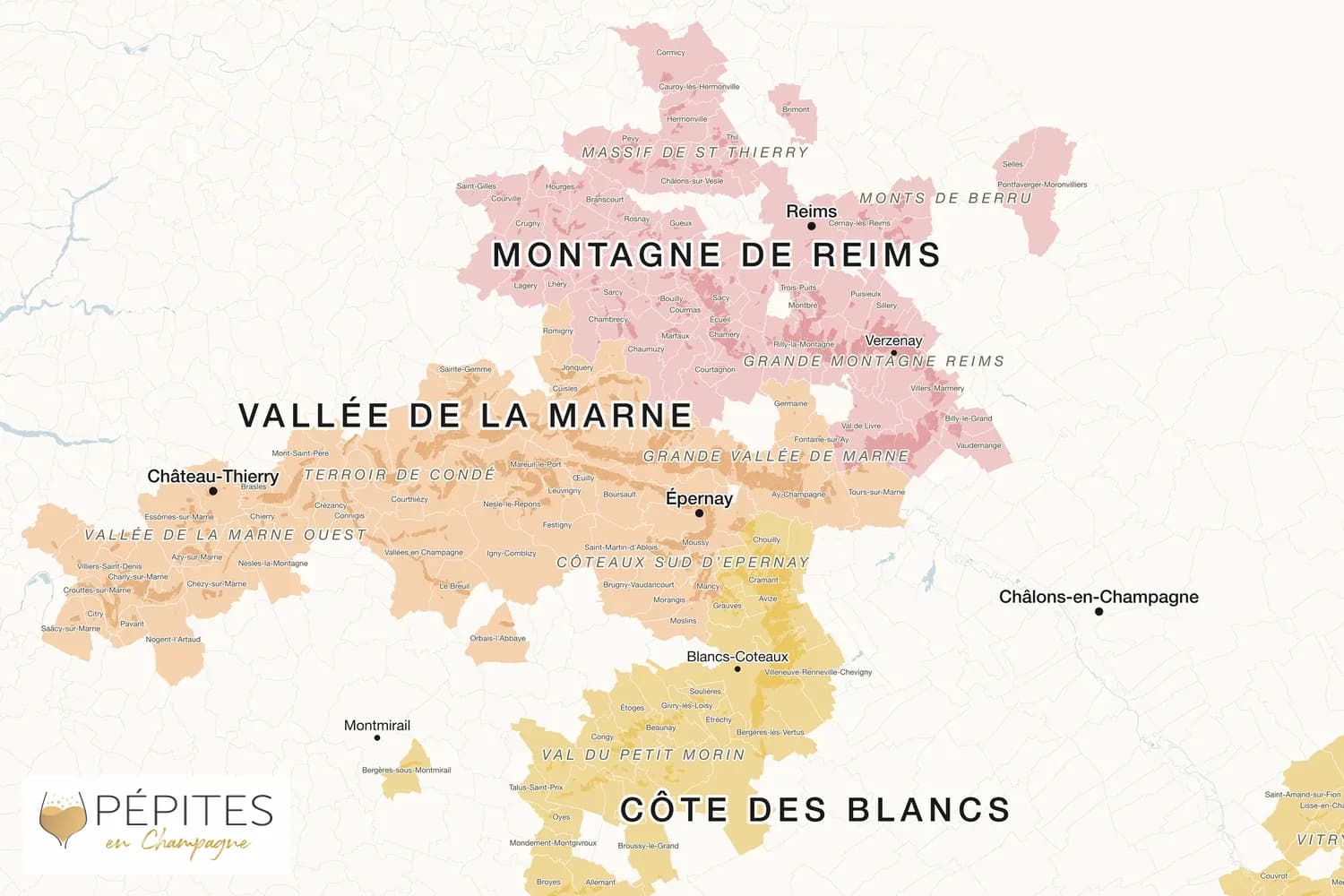
Map of the Champagne vineyards: the 4 regions of Champagne and their crus
The essentials
The Champagne vineyards cover 34,317 hectares spread across 319 crus and four regions: the Vallée de la Marne (12,150 ha, kingdom of meunier), the Montagne de Reims (7,966 ha, pinot noir and 9 of the 17 grands crus), the Côte des Bar in the Aube (7,898 ha, pinot noir) and the Côte des Blancs (6,304 ha, chardonnay).
What are the 4 regions of the Champagne vineyards?
The Montagne de Reims, the Vallée de la Marne, the Côte des Blancs (with the Sézannais, the Vitryat and Montgueux) and the Côte des Bar, in the Aube. Together, they comprise 319 crus and 34,317 hectares of classified vines.
What is the largest wine-growing region in Champagne?
The Vallée de la Marne, with 103 crus and 12,150 hectares, more than a third of the vineyards. It stretches from Tours-sur-Marne to the edge of Château-Thierry, in the Aisne.
Where are the grands crus of Champagne located?
All 17 grands crus are in the Marne: 9 in the Montagne de Reims (including Verzenay, Bouzy, Ambonnay), 6 in the Côte des Blancs (including Cramant, Avize, Le Mesnil-sur-Oger) and 2 in the Vallée de la Marne (Aÿ and Tours-sur-Marne). The Côte des Bar has none.
What is the distance between Reims and Épernay?
About thirty kilometres by road, through the Montagne de Reims. This is the heart of the vineyards: the great Houses of Reims on one side, the avenue de Champagne in Épernay on the other, both inscribed together on the UNESCO World Heritage list since 2015.
The map of the Champagne vineyards at a glance: four regions, 319 crus and 34,317 hectares from the Montagne de Reims to the Côte des Bar. Click on a village to see its crus, its plot map and its houses.
9 min read
Located in the north-east of France, the Champagne wine region is the northernmost vineyard in France. It covers 34,317 hectares of classified vines, spread across 319 crus and four major regions, from the Montagne de Reims to the Côte des Bar, in the Aube. The map below shows them all.
The map of the Champagne vineyard
Each colour corresponds to a region; the pale shade marks the cru's territory, the deeper shade the vineyard itself. Zoom in, move the map and click on a village: you will see its region, its terroir, its classified hectares, its plot map and the houses from our cellar based there. The search also accepts the name of a house.
Loading map…
The 4 regions of the vineyard in figures
Region
Crus
Hectares
Grands crus
Premiers crus
Leading grape variety
Vallée de la Marne
103
12,150
2
9
Meunier
Montagne de Reims
94
7,966
9
25
Pinot noir
Côte des Bar
64
7,898
0
0
Pinot noir
Côte des Blancs
58
6,304
6
8
Chardonnay
Total
319
34,317
17
42
The vineyard spreads mainly across the Marne, but also the Aube, the Aisne and, more marginally, the Haute-Marne and the Seine-et-Marne. It accounts for less than 5% of France's total vineyard area. A cru is a village: its classification as grand cru or premier cru applies to all its vines. For the full list of villages, commune by commune, see our Atlas of Champagne Crus.
The Montagne de Reims, land of pinot noir
The Verzenay lighthouse overlooks the "sea of vines" of the Montagne de Reims.
The Montagne de Reims is a wooded plateau between Reims and Épernay, ringed by vine-covered slopes. The word "montagne" comes from the rise between the Champagne plain and the cuesta, an asymmetrical landform with a steep slope on one side and a gentle one on the other; here the vines climb to around 200 metres. It has 94 crus and 7,966 hectares, including 9 of the 17 grands crus: Ambonnay, Beaumont-sur-Vesle, Bouzy, Louvois, Mailly-Champagne, Puisieulx, Sillery, Verzenay and Verzy.
The heart of the region is the Grande Montagne de Reims (21 crus, 4,040 ha), where the chalky subsoil gives pinot noir wines that are fresh, powerful champagnes with good ageing potential. Around it lie the Reims, Vesle and Ardre sector (51 crus), the Massif de Saint-Thierry to the north-west (17 crus) and the Monts de Berru to the east (5 crus). Chardonnay is planted on the eastern slopes, at Villers-Marmery and Trépail; meunier is found more to the west, around Ludes and Rilly-la-Montagne. The Verzenay lighthouse, built in the early 20th century by Joseph Goulet, offers a panoramic view over what its builder called the "sea of vines" and houses a vine museum.
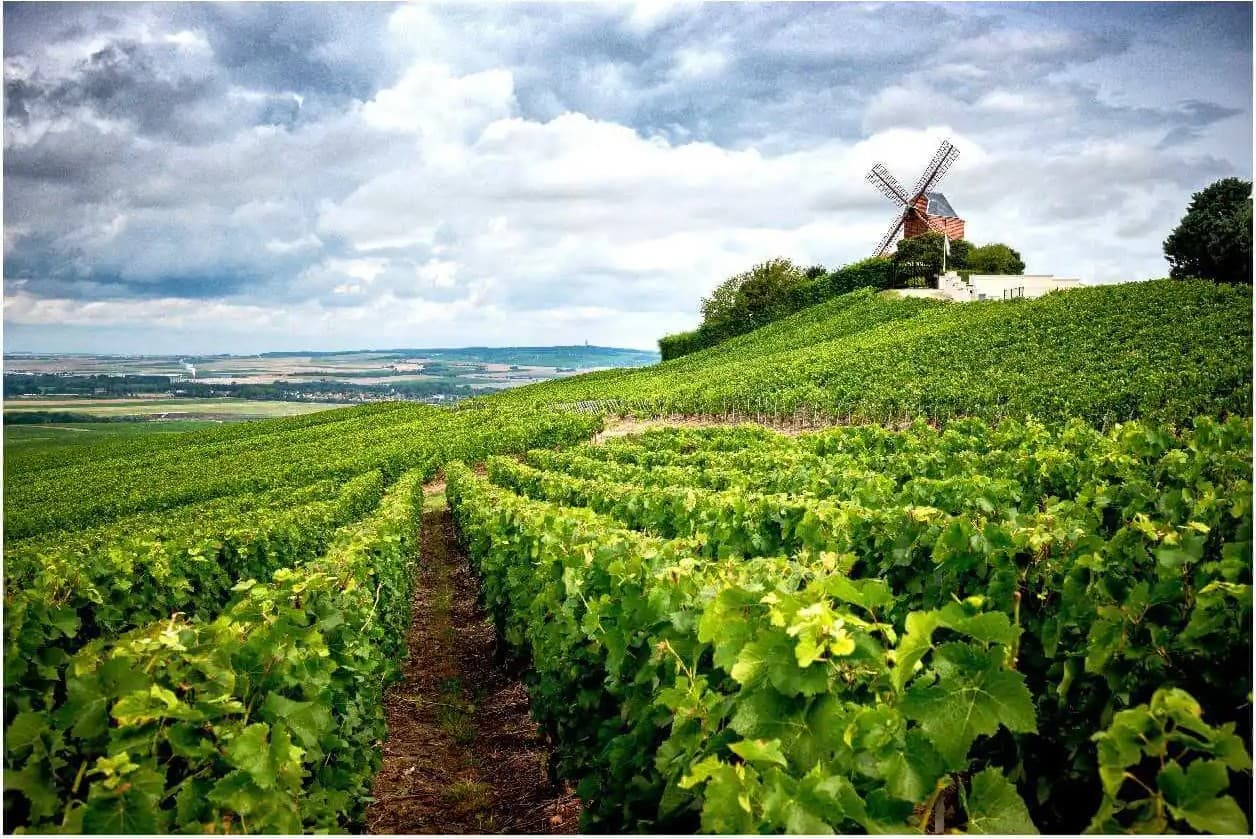
The slopes of the Vallée de la Marne, on either side of the river.
With 103 crus and 12,150 hectares, the Vallée de la Marne is the largest region of the vineyard. It begins in the east, at Tours-sur-Marne, and follows the river westward through Aÿ, Épernay and Hautvillers, as far as the gates of Château-Thierry, in the Aisne. It has 2 grands crus, Aÿ and Tours-sur-Marne, and 9 premiers crus.
Its terroirs change from one end to the other: the Grande Vallée de la Marne around Aÿ (12 crus, 1,941 ha), the right bank (24 crus, 3,070 ha) and the left bank (14 crus, 2,442 ha), the Coteaux sud d'Épernay (11 crus), then the western Vallée de la Marne (38 crus, 2,700 ha) and the Terroir de Condé. Pinot noir dominates near the Montagne de Reims, on limestone soil; meunier takes over further west, on steep, clay-marl slopes. This contrast is what gives the blends their richness.
Hautvillers, birthplace of Dom Pérignon
A picturesque village with winding streets, Hautvillers is renowned for its premier cru vines and its abbey, where the monk Dom Pérignon is buried. He managed its estates for almost 50 years, with the ambition of creating "the best wine in the world"; his name is now that of the prestige cuvée Dom Pérignon.
Chalk, a water reserve for the vines, also serves as a natural cellar for champagne.
The Côte des Blancs begins south of Épernay and runs due south for around twenty kilometres, at right angles to the Vallée de la Marne. Its slopes, facing east and south-east, are planted between 100 and 200 metres in altitude, sheltered from the prevailing winds. It is the birthplace of chardonnay, which gives the region its name. It has 58 crus and 6,304 hectares, including 6 grands crus: Chouilly, the largest in the whole of Champagne (526 ha), Le Mesnil-sur-Oger, Oger, Cramant, Avize and Oiry.
The heart of the Côte des Blancs (10 crus, 3,190 ha) rests on exposed chalk, a true reservoir of water and heat: it stores the day's warmth to release it at night, drains excess water and reflects light onto the vines. Each grand cru has its own signature: the minerality and citrus notes of Avize, the fruity elegance of Chouilly, the pastry notes of Oger, the fullness of Mesnil-sur-Oger, the concentration of Cramant. The region also extends to the Val du Petit Morin (20 crus), the Sézannais (12 crus, 1,418 ha), where clay and sand cover the chalk, the Vitryat around Vitry-le-François (15 crus) and the isolated hill of Montgueux, near Troyes.
The Côte des Bar, the Champagne region of the Aube
The Côte des Bar — "bar" meaning "summit", in reference to its landscape — is the southernmost region of the vineyard, south of the Aube, closer to Chablis than to Reims. It has 64 crus and 7,898 hectares, in two areas: the Barséquanais around Bar-sur-Seine and the Riceys (33 crus, 5,472 ha) and the Bar-sur-Aubois (31 crus, 2,425 ha). Long considered a secondary zone, it was only fully integrated with the 1927 law that delimited the appellation.
Its subsoils are made of marl, a mix of limestone and clay similar to that of neighbouring Burgundy. Once planted with gamay, it now mainly produces a round, fruity pinot noir, prized for its freshness. It has neither a grand cru nor a premier cru, but it is the only region that combines three appellations: champagne, coteaux-champenois and rosé des Riceys.
Cool climate and chalky subsoil: France's northernmost vineyard.
The Champagne wine region lives under a dual climatic influence: continental, with summer sunshine, and oceanic, with moderate rainfall spread throughout the year. The annual average is around 11°C. Frost remains the main danger: in winter it can destroy the vines, in spring it burns the buds. This cool climate produces taut wines with great aromatic finesse.
The subsoil is mainly limestone. The chalk was deposited in the Cretaceous period, from the Latin creta, "chalk", when the sea covered the region; it contains fossils of belemnites and sea urchins. Very present in the Côte des Blancs and the Montagne de Reims, it drains the soils, moderates temperature swings and brings acidity and minerality. Further south and west, it gives way to clay or marl soils, which give more roundness. The vineyard is also highly fragmented: nearly 280,000 plots, averaging around twelve ares each, which allows for single-plot cuvées. To find out more: soil and subsoil of the Champagne vineyard.
Pinot noir, meunier and chardonnay: the appellation's three main grape varieties.
A vineyard over a thousand years old
Planted late because of its climate, the Champagne vine is thought to date back to the 7th century, or even the 5th. The Grande Charte champenoise of 1114 is its founding act: Guillaume de Champeaux, Bishop of Châlons, confirmed in it the possessions of the Abbey of Saint-Pierre-aux-Monts, whose monks planted vines on the best land. Champagne wine became the wine of coronations; in 1728, Louis XV authorised its shipment in bottles, the first step towards export. A victim of its own success and of counterfeiting, the appellation was protected by the law of 6 May 1919, supplemented by that of 22 July 1927, which set the production area. After phylloxera and the First World War, the vineyard was rebuilt to reach its current 34,317 hectares. It mainly produces champagne, and, more rarely, still wines: coteaux-champenois and rosé des Riceys.
Visiting the vineyard: where to start?
Reims and Épernay are the two gateways, around thirty kilometres apart via the Montagne de Reims. The Champagne Hillsides, Houses and Cellars have been a UNESCO World Heritage Site since 2015: the historic hillsides of Hautvillers, Aÿ and Mareuil-sur-Aÿ, the Saint-Nicaise hill in Reims, with its chalk pits dug into the chalk, and the Avenue de Champagne in Épernay. The Verzenay lighthouse, the Hautvillers abbey and the Côte des Blancs from Avize to Mesnil-sur-Oger can easily be done in a day; the Côte des Bar, further south, deserves a separate stay, around the Riceys and Essoyes. To choose your bottles before or after your visit, see also our selection of the best champagne and bottle sizes.